Why binary options show up in festival culture at all
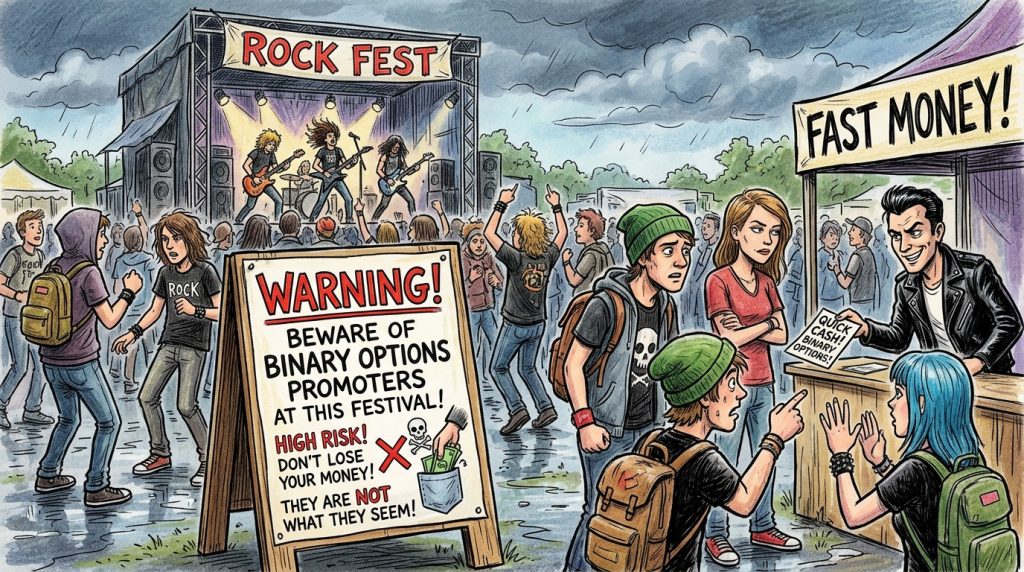
Rock festivals are built around compression. Crowds, noise, time pressure, branding, alcohol, social proof, and a general sense that everything is happening now. That environment is good for music. It is also good for bad financial promotion.
Binary options fit that setting unusually well. They are marketed as fast, simple, and exciting. The basic proposition is stripped down to a yes-or-no call on price direction over a short time window. That simplicity makes them easy to explain in a queue, at a pop-up booth, in a sponsored lounge, or through a QR code pushed in a messaging group that formed around the event.
The problem is that simplicity in sales is not the same thing as simplicity in risk. Regulators have spent years warning that binary options are not ordinary investing products. In the UK, the Financial Conduct Authority states plainly that from 2 April 2019 firms were banned from selling binary options in the UK and that if you are offered binary options, it is probably a scam. In the EU, ESMA prohibited the marketing, distribution, and sale of binary options to retail investors because of significant investor-protection concerns. Australia took a similar route, with ASIC banning the issue and distribution of binary options to retail clients from May 2021 after concluding they had resulted in significant detriment.
So the warning here is not abstract. If binary options are being promoted around a rock festival, the pitch is already colliding with a long regulatory record that says these products cause predictable harm to ordinary people.
What binary options actually are, and why regulators banned them
A binary option is usually presented as a stripped-down market bet. Price will be above a level at a set time, or below it. If the guess is correct, the customer receives a fixed payout. If it is wrong, the customer loses the stake. The FCA’s consumer warning describes that structure directly: if the investor is correct, they “win”; if they are wrong, they lose the full investment.
That description matters because it explains why regulators became so hostile to the product. Binary options look like a financial instrument, but the user experience is much closer to betting than to investing. There is no gradual participation in a business, no ownership of an asset, and no long holding period in which value can compound. There is a fixed, short-horizon outcome and a full loss when the call is wrong.
The UK ban was not just symbolic. When the FCA confirmed its permanent ban in 2019, it said the measure could save retail consumers up to £17 million per year and reduce the risk of fraud by unauthorised entities claiming to offer the products. You can read more about why FCA banned binary options by visiting BinaryOptions.co.uk. ESMA’s intervention at EU level rested on the same logic: binary options posed such strong investor-protection concerns that prohibition, not disclosure, was the appropriate response for retail clients. ASIC used similar language in Australia, stating that binary options had resulted in and were likely to result in significant detriment to retail clients.
The U.S. investor warning is also blunt. The SEC’s Investor.gov page says much of the binary options market operates through internet-based trading platforms that may not be complying with applicable regulatory requirements and may be engaging in illegal activity.
That is the background any festival promotion should be measured against. These are not misunderstood mainstream investments unfairly treated by regulators. They are products that multiple major regulators judged harmful enough to ban or warn against in unusually direct terms.
Why rock festivals are a useful hunting ground for promoters and scammers
A rock festival is not just a concert. It is a temporary city where normal filters are weaker.
People are already in spending mode. They are scanning phones constantly, joining temporary chat groups, sharing contacts, following sponsor activations, and making rapid decisions in an environment designed to reward novelty. That is a useful setting for any product that benefits from impulse, especially one sold through the language of excitement and insider access.
The festival crowd is also mixed. You get students, casual professionals, hobby traders, crypto-curious attendees, and people who have enough disposable income to feel they can “try something small.” A promoter does not need everyone to convert. They only need a few people willing to scan a code, join a Telegram or WhatsApp channel, and follow up later.
That matters because investment fraud no longer depends only on public web ads. Recent Reuters reporting on illegal financial ads in Britain showed that online platforms were still carrying large volumes of likely scam promotions despite prior commitments to tighten controls. Once a contact is made at a physical event, the real selling often moves into private messaging, where supervision is weaker and pressure tactics work better.
Festival culture also creates borrowed trust. If something appears physically near an event, on branded wristband material, in an influencer after-party clip, or in a “VIP trading lounge” style activation, people often assume some level of vetting happened. That assumption is unsafe. Sponsorship style does not equal regulatory legitimacy.
The result is that a festival is not just a backdrop. It is an efficient filter for people who are emotionally open, socially primed, and temporarily less defensive about commercial pitches dressed up as lifestyle add-ons.
The sales script: how the pitch is made
The pitch for binary options near music events is rarely framed as “please come gamble on short-term price direction.” It is dressed more carefully than that.
The first layer is aspiration. The promoter links the product to the atmosphere around the festival: freedom, speed, insider access, doing things differently, not working a normal schedule, getting ahead while others are just consuming. The language is familiar from broader trading marketing, but in a festival setting it is amplified by mood. You are not just buying a product. You are being invited into a lifestyle cluster.
The second layer is simplification. Binary options are pitched as easier than “real trading.” No need to understand balance sheets, macroeconomics, or valuation. Just predict whether price will go up or down over a short period. The complexity of markets is replaced by a coin-flip style decision that feels manageable after thirty seconds of explanation.
The third layer is false safety. The seller may mention “licensed brokers,” “regulated platforms,” “VIP analyst groups,” or “managed signals.” That language matters because the actual regulatory position is the opposite. In the UK, if you are offered binary options, the FCA says it is probably a scam. In the U.S., Investor.gov warns about fraudulent promotion schemes involving binary options and binary options trading platforms.
The fourth layer is urgency. The event itself provides natural urgency. “Festival special.” “Join before midnight.” “This promo ends after the headline set.” “Our analyst call is in an hour.” That time pressure is not accidental. It reduces verification.
Once the person enters the funnel, the contact often moves off-site. A messaging group is formed. Screenshots of winning trades appear. A handler or “account manager” starts direct contact. At that point the festival was only the front door. The real grooming starts later, usually in a quieter setting where the person thinks they are making a deliberate decision, not reacting to an event atmosphere.
The structural problem: binary options are built to feel simple and behave badly
The problem with binary options is not only that scammers like them. The structure itself is hostile to ordinary investors.
The all-or-nothing payout format makes the product feel intuitive, but that intuition is misleading. Simplicity on the surface hides poor economics underneath. When the product is framed as a short-term yes-or-no decision, users tend to treat it like a game of judgment or momentum rather than a high-friction financial bet with an embedded disadvantage.
That is why regulators did not merely ask firms to improve disclosure. ESMA prohibited the sale and marketing of binary options to retail clients across the EU because the concern was the product itself, not just sloppy advertising. ASIC reached the same conclusion in Australia. The FCA went further in consumer-facing language by telling the public that if binary options are being offered to them, it is probably a scam.
This is an important distinction. Some financial products are risky but legitimate when used properly. Binary options have been treated by major regulators as something worse: a product category with such a poor retail outcome profile that prohibition was justified.
At a rock festival, that structural weakness gets disguised as accessibility. The short duration looks exciting rather than dangerous. The fixed payout looks clear rather than predatory. The mobile-first interface looks modern rather than disposable. The same features that help sell the product are the ones that make it unsuitable for most people.
You can learn more about the good, the bad and the ugly of binary options by visiting BinaryOptions.net. Binaryoptions.net is a website that tries to take a neutral approach to binary options, to neither promote them nor scold those who want to try trading binary options.
The warning signs around any festival-linked binary options pitch
The clearest warning sign is very simple: binary options should not be showing up as a normal investment opportunity for retail consumers in the first place. In the UK, that offer alone is enough for the FCA to tell consumers it is probably a scam.
Beyond that, there are recurring signs that the pitch is bad.
If the offer relies on QR codes, Telegram groups, WhatsApp lists, or “VIP access” rather than a plainly identifiable regulated firm with independently verifiable details, that is a problem. If the main sales language is about easy wins, short windows, secret signals, or a trader “mentor” who can guide you from your phone, that is a problem. If the person pushing the offer wants a quick sign-up and a first deposit before you leave the venue or before the event weekend ends, that is a problem.
Payment instructions matter too. If the platform asks for crypto deposits, transfers to unfamiliar accounts, or unusual top-up methods rather than ordinary, transparent funding routes with a regulated firm, the risk level jumps immediately. The SEC’s fraud warning notes that many binary options platforms may be operating illegally online.
Another warning sign is social camouflage. The promoter may not even say “binary options” at first because the term carries baggage. They may use softer wording such as “fixed return trades,” “yes/no positions,” “micro-options,” or “short-cycle market calls.” Renaming a bad product does not improve it.
The final warning sign is that the product is being paired with entertainment culture at all. Serious investing does not need to borrow the psychology of a festival crowd to make its case. If a financial product only feels attractive when wrapped in amplified music, social buzz, and event urgency, the product is probably weak on its own merits.
What to do instead if you want music-linked investing without the nonsense
Some people respond to these pitches because they like the idea of combining music culture with money. That instinct is understandable. The solution is not binary options. It is to separate the cultural theme from the financial structure.
If you want exposure to the economics of music, use ordinary public-market instruments instead. Publicly traded music-related companies such as Warner Music Group, Universal Music Group, Live Nation, Spotify, or a music-themed ETF like MUSQ are at least recognisable investments held through standard brokerage accounts with ordinary custody and disclosure.
That does not make them risk-free. It makes them real. You are buying shares in businesses, not wagering on a price level five minutes from now because someone at a festival booth told you the move was obvious.
If the attraction is not music-industry exposure but simply the thrill of “quick trades,” that is worth naming honestly. It is not investing. Once that is clear, most of the marketing power disappears. The product becomes what regulators have already told you it is: a high-risk, scam-adjacent retail trap that does not belong in a serious portfolio.
Final view
Binary options promoted at rock festivals should be treated as a red flag, not as a quirky side offer for financially adventurous fans.
The regulatory position is already unusually clear. The FCA banned retail binary options in the UK and says that if you are offered them, it is probably a scam. ESMA prohibited them for retail investors across the EU. ASIC banned them in Australia because of significant detriment to retail clients. U.S. investor warnings continue to flag fraudulent promotion schemes involving binary options platforms.
Festival settings do not soften that conclusion. They make it worse. The crowd dynamics, time pressure, social proof, and private-message follow-up all increase the chance that someone mistakes a bad product for a modern one.
So the practical rule is plain. If binary options appear next to a stage, a sponsor tent, an after-party invite, or a QR code handed out in a festival crowd, do not treat that as innovative finance. Treat it as a warning that the seller needs atmosphere because the product cannot survive calm scrutiny.